
|
| CASE STUDY |
Additional Resources
Project Profile
Location: Bridgeview (Chicago), Illinois
Venue: Sports Stadium Designed Specifically for Professional Soccer
System Type: Underground Turf Conditioning
Installer: Christopher J. Bennett
Uponor products mentioned in this case study
|
COMMERCIAL: Underground Turf Conditioning
TOYOTA PARK Downloadable Resources: Case Study (.pdf) | Text (.txt) | Image Gallery (hi-res .tif)
Located on the Southwest side of the city, the new $70 million, 20,000-seat Toyota Park will serve as the home of the Chicago Fire, a Major League Soccer franchise whose season potentially stretches from early April to mid-November, depending upon how far the team advances in the annual MLS Cup Playoffs. There are also plans for local high school football teams to make use of the field as well. As is the case at Soldier Field and other stadiums across the country, the turf-conditioning system at Toyota Park circulates a warm, water-and-glycol mixture through underground tubing, made of crosslinked polyethylene (PEX). The intent is to warm the root zone beneath the grass, so that the playing surface remains soft and forgiving to falling players, even at sub-freezing temperatures.
A pair of commercial-grade, 150-horsepower boilers, situated in a mechanical room under the concrete stands on the east side of the field, feed the 50%-glycol solution through two heat exchangers and 1,400 feet of four-inch copper supply and return piping, on their way to roughly 400 feet of manifold. Because so much of it is encased in concrete under the stands, the copper portion of the system had to be thoroughly tested at high pressures even before the PEX tubing was completely installed on the field. “We had to be sure there were absolutely no problems,” says Bennett. “Once the concrete is poured, it’s pretty difficult to fix any leaks.” The glycol solution comes off the two boilers at 180°F, while the use of mixing valves reduces the temperature of the solution to a maximum of 130°F before pumping it into the 168 loops of underground PEX piping that transverse the field. As the outdoor temperature falls, the system automatically boosts the water temperature in the tubing to protect the turf root system. “It is a closed, reverse-return system that is self-balancing,” Althoff’s Bennett explains. “The first half of each loop functions the supply line, moving the fluid from the copper manifold at the south end to the far north end of the field. The return line brings the solution back to that manifold, which then moves it to the boilers underneath the stands for reheating and recirculation.”
SMOOTH SLEDDING: Sports Construction Group, the Cleveland, Ohio-based contractor responsible for building the playing surface at Toyota Park, began the installation process in early November 2005 by laying a four-inch foundation made of pea gravel. The earth-moving machinery used here was equipped with a laser to guide the grading process, so that the finished surface was perfectly flat. In the aftermath of this careful grading, Althoff’s 10-man installation crew was not permitted to step onto the gravel while installing the PEX loops.
The rail system is a major upgrade over an older method of securing the tubing to the field. The latter involves hand-tying the PEX to a wire grid covering the pea-gravel surface. That process is not only more time-consuming, but also requires more bending and crouching by the installer. “”I don’t care how good a shape the installers are in,” says Bennett. “With the hand-tying approach, they could have back problems before too long. We have quality people on our team, and if we lose one of them to injury, it may take us awhile to find an equally qualified replacement. With the railing system, we move more quickly with no bending, so no one gets hurt.”
SOMETHING DIFFERENT, SOMETHING SPECIAL: The spectacle of 10 grown men chasing a kid’s sled up and down a soccer field, as it spins a web of plastic tubing from end to end, is bound to attract attention. “All the other trades have a tendency to stop and watch us,” says Bennett, “and that’s really kinda cool. At Althoff, we get involved in sorts of construction projects, but a job like this one or the one at Soldier Field gives our guys a little break from the norm, and they get excited about that. “Plus, there’s the extra visibility of a major project like this to the wider community,” he continues. “When our guys drive by Soldier Field – or, now, this Toyota Park – with friends or family, they can say: ‘Hey, we put a turf-conditioning system into that field!’ That work is going to be around for a long time and experienced by a lot of people. That gives our crew members an extra-special buy-in.” The design information in this case study is provided for illustrative purposes only. The actual requirements of similar projects will depend on regional climatic conditions, project-specific heat loss, owner expectations, applicable building codes, etc. Please contact your Uponor representative for assistance in designing your specific projects. # # # For more information about the benefits of cross-linked polyethylene (PEX) tubing, contact a reputable manufacturer, such as Uponor North America (www.uponor-usa.com). For editorial assistance, contact:
Hi-res versions of images (some shown on this page with many others) are available for immediate download in .tif format by using this link: up0636.shtml
|
 The newly built Toyota Park – the fourth major soccer-specific field in the United States – features a state-of-the-art, turf-conditioning system that will keep the playing surface in excellent, player-friendly condition year-round, no matter the weather or temperature. Manufactured by Uponor, Inc. (formerly Uponor Wirsbo), the system was installed in November 2005 by Althoff Industries, which built a similar system during the 2003-2004 renovation of Soldier Field, home of the National Football League’s Chicago Bears. Althoff senior vice president Christopher Bennett supervised both projects as well as assisted his firm’s initial foray into turf conditioning in 1998 at the Bears’ practice field in Lake Forest, Illinois.
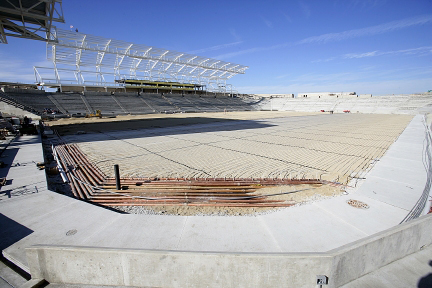 The radiant heating system consists of roughly 28 miles (over 150,000 linear feet) of ¾-inch Uponor Wirsbo hePEX plus tubing, that serpentines from end zone to end zone, eight inches on center and ten inches below the 200-foot by 425-foot playing surface. The only connections are at the copper manifolds, positioned at the south end of the field, where each PEX loop begins and ends – thus removing potential service issues to outside the playing area. The copper headers are fitted with stubouts at the factory for making the PEX connections, saving substantial time on the job site.
 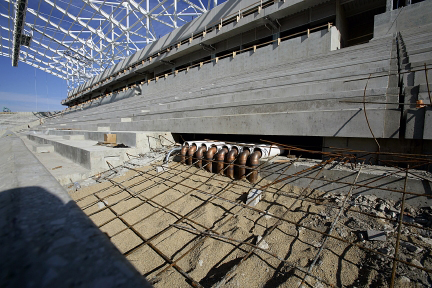 FOUR HEATING ZONES: Like the interior of a home or a large office, the field is segmented into four heating zones, also running the length of the field from goal to goal. Each zone contains 42 PEX loops and two temperature sensors that sit within underground boxes connected to one another with plastic conduit. On sunny days, the demand for warmth varies from zone to zone, depending on the position of the sun. The sensors in each zone communicate an average demand back to a series of control valves, which modulate the flow of warm water in response. The objective is to keep the root system at a consistently comfortable 65°F, says Bennett. “The field is warm and moist enough that it can actually grow grass in December or even January,” he remarks. “The freezing point for the glycol mixture is minus-25 degrees, so the system can be filled with fluid year-round, without the hassle and expense of draining and re-filling it prior to each season.” But what happens if any of the underground sensors ever need to be repaired? All eight are on a GPS (Global Positioning System), according to Bennett, enabling service personnel to pinpoint the positions of the underground boxes to within 18 inches. “We also provide a complete photo log of the boxes’ installation, which should also help in locating them,” he says.
 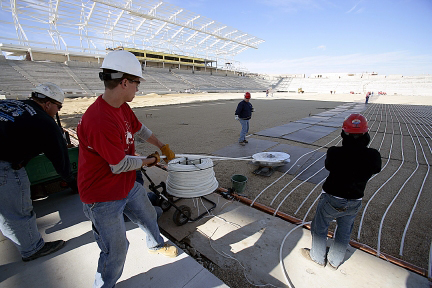 Bennett and company faced a similar dilemma at Soldier Field in 2003. Their solution then and, again, at Toyota Park was a motorized carrier built from a child’s snow sled that could run unmanned the length of the field. The Althoff crew fit the sled with a sheet-metal spool and tethered the sled to motorized pulleys behind each end zone. The Wirsbo hePEX™ plus tubing was looped around the spool: one end was held at the copper manifold; the other, to a reel holding the rest of the 850-foot hePEX™ plus coil. The sled ran atop numerous 4´ x 6´ Masonite sheets that were laid end to end across the field. As it moved from end zone to end zone, the sled pulled the tubing over a series of plastic tracking rails positioned at intervals. Installers followed the sled down the field, walking on the same plywood planks to avoid dimpling the pea gravel, and snapping the hePEX™ plus into place on the rails with their shoes.
 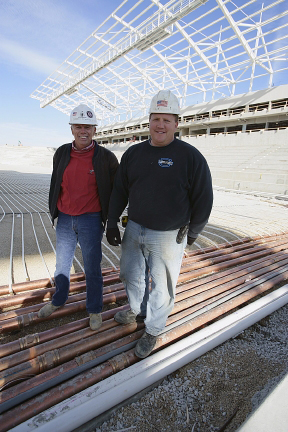 Bennett reports that the Toyota Park installation ultimately went as smoothly as Althoff’s previous work at Soldier Field, due in part to having the same field team, led by John Lavin and Jay Althoff. The entire tubing system was firmly in place after only five days. “Speed – getting the tubing down quickly and properly – is a premium value on a job like this,” says Bennett. “Because of rains in October, our startup was delayed by a week and a half. Once we finally had an opening in the weather, we had to get the job done before it turned bad again and we found ourselves working in a mud hole.” Only two days after the Althoff crew finished, the PEX tubing was buried in 10 inches of rootzone medium [a mixture of USGA sand and peat moss] and 1-5/8 inches of premium Kentucky bluegrass sod.